2026 Buffalo Bills Offseason Review & Preview
Lucian Gao
·
For the third straight year, the Buffalo Bills’ season ended with a three-point playoff loss and another shot at the Super Bowl slipping away. Their last three exits have come by scores of 27–24, 32–29, and 33–30. This time, the team standing in their way was Denver, led by Bo Nix. The AFC offered its most open path to a championship in years, and Buffalo still couldn’t get through. After three consecutive losses by such narrow margins, bad luck is wearing thin as an explanation. With Josh Allen in his prime, 2025 may go down as the opportunity in Buffalo’s championship window it could least afford to waste.
Still, the 2025 Bills were a very good team. They won 12 games, James Cook claimed the NFL rushing title, and the offense remained among the league’s most efficient. Josh Allen gave them a chance to win every time they took the field. Those strengths, however, did little to resolve the problems that have followed Buffalo through its recent playoff runs. In the biggest moments, the offense still leaned heavily on Allen to create something, while the defense lacked a reliable way to take control of a game. The regular season reaffirmed Buffalo’s high floor without offering much evidence that its playoff ceiling had risen.
By the Numbers of 2025 season
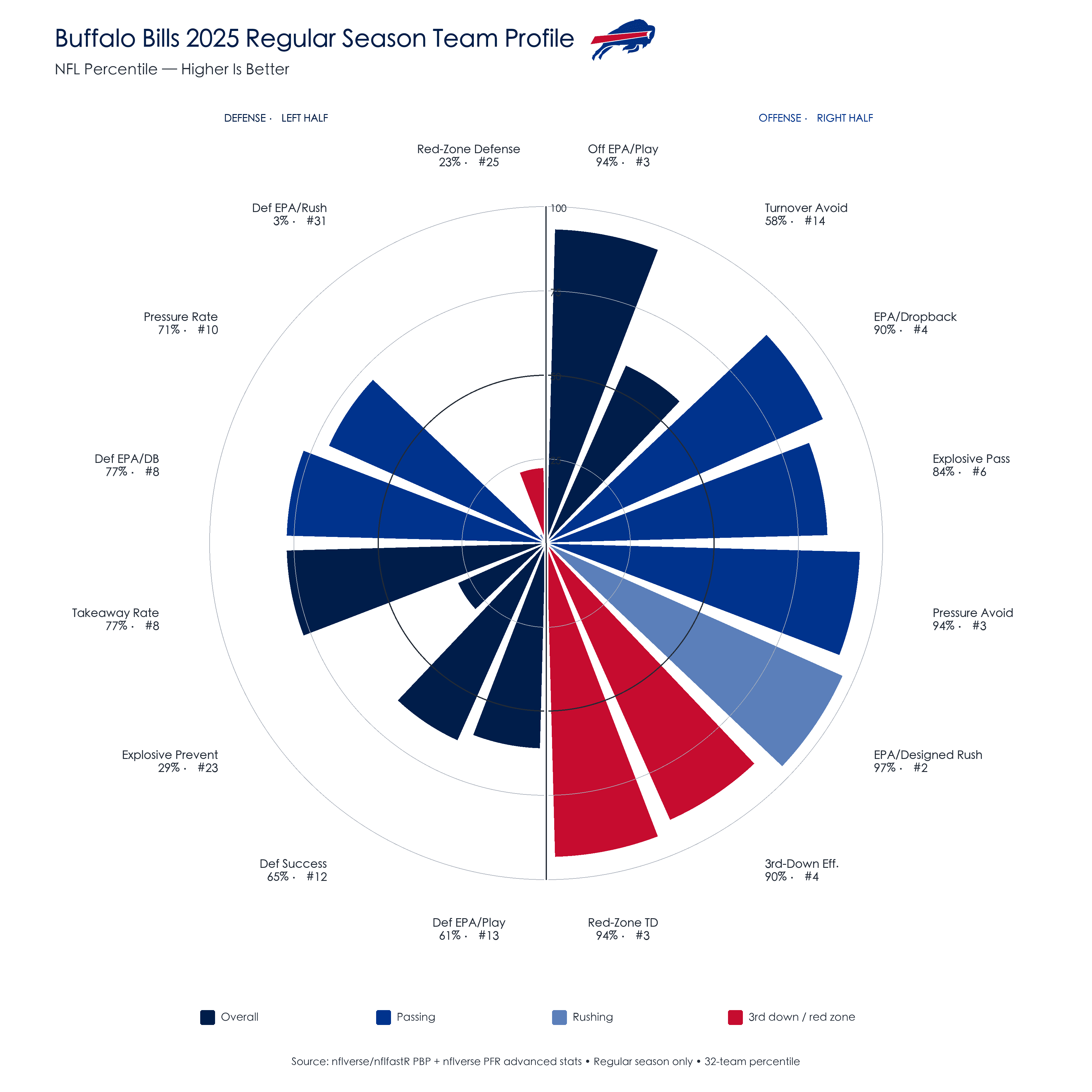
The numbers point to run defense as Buffalo’s biggest weakness. The Bills ranked 31st in defensive EPA per rush. That starts inside, where they lacked an anchor who could consistently absorb double-teams, hold the A-gaps, and keep the linebackers behind him clean. Ed Oliver’s game is built around first-step quickness and penetration as a 3-tech. Holding ground and controlling multiple gaps as a traditional Nose Tackle asks him to play away from those strengths. Meanwhile, Sean McDermott’s defense prioritized speed, coverage, and rotation up front. When the defensive tackles failed to control the initial blocks, Buffalo’s lighter linebackers and nickel personnel were left taking on offensive linemen with clean paths to the second level. Matt Milano’s declining play and injuries further reduced the margin for error. Opponents could sustain drives on the ground and break off the kind of explosive runs that change a game.
The offensive rankings look close to faultless, but the scheme cannot take all the credit. Buffalo ranked third in pressure avoidance and sixth in explosive passing. Much of that came from Allen moving, escaping pressure, and using his arm to create opportunities after protection broke down or his first read was covered. He turned plenty of broken plays into productive ones, lifting the efficiency of the entire offense in the process. That leaves a question worth asking: when Allen plays within structure, can Joe Brady’s designs consistently produce open receivers and explosive passes? If they can’t, those elite numbers tell us a great deal about Allen’s value while potentially concealing the offense’s underlying problems.
Coaching Staff
HC: Sean McDermott → Joe Brady
OC: Joe Brady → Pete Carmichael Jr.
DC: Bobby Babich → Jim Leonhard
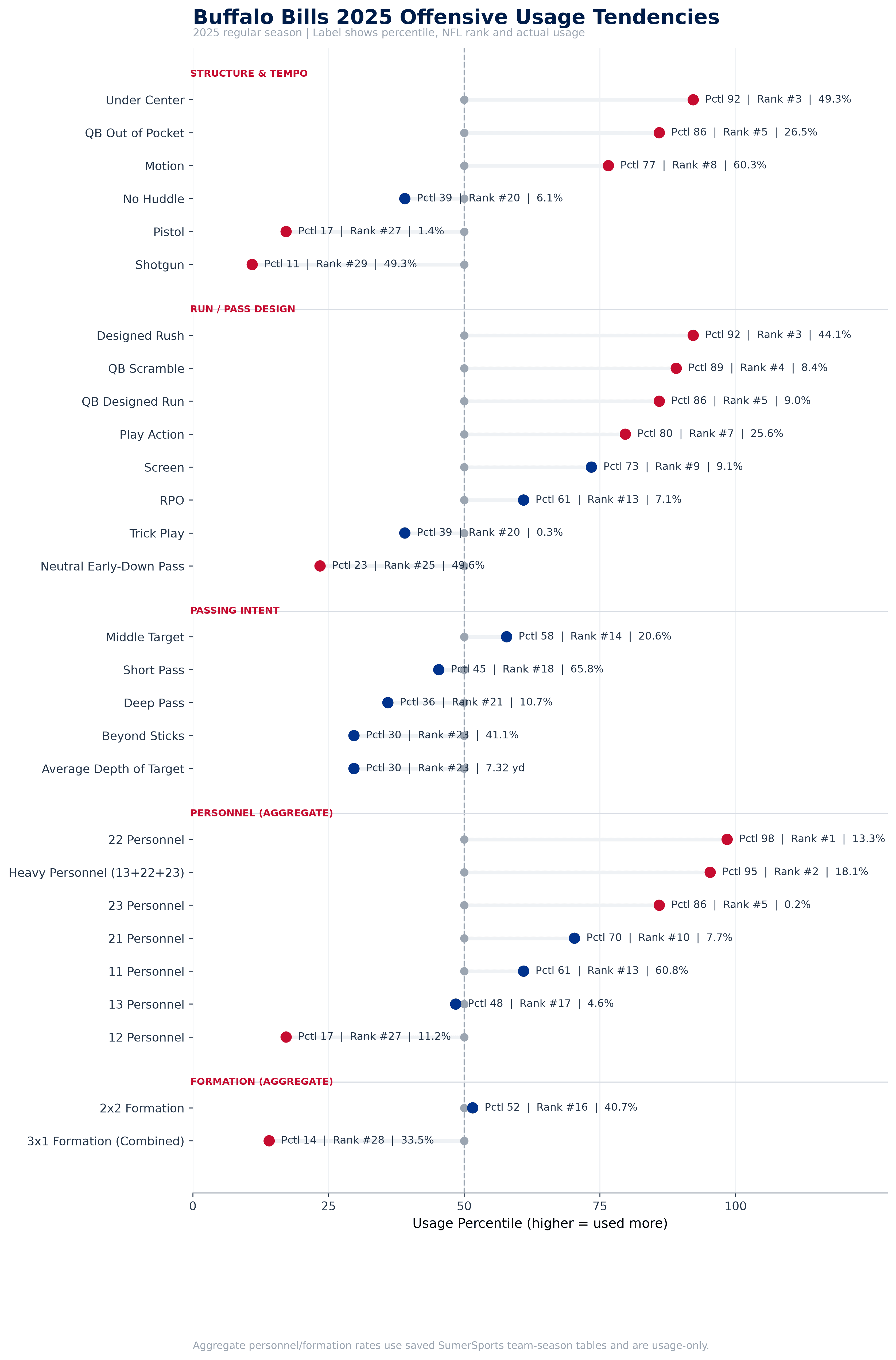
Joe Brady is at his best when he’s working around his players’ weaknesses. He uses screen and mesh to get receivers free, punishes light boxes with weak-side zone runs, and ties the short passing game, the run game, and Allen’s mobility into a dependable offense. Buffalo ranked 3rd in under-center usage, third in designed run rate, and 7th in play-action rate. The Bills also led the league in 22 personnel usage and ranked second in heavy personnel. Brady has deliberately reduced the offense’s reliance on receivers winning one-on-one, leaning on James Cook, two-tight-end sets, and Allen’s threat as a runner to keep things moving.
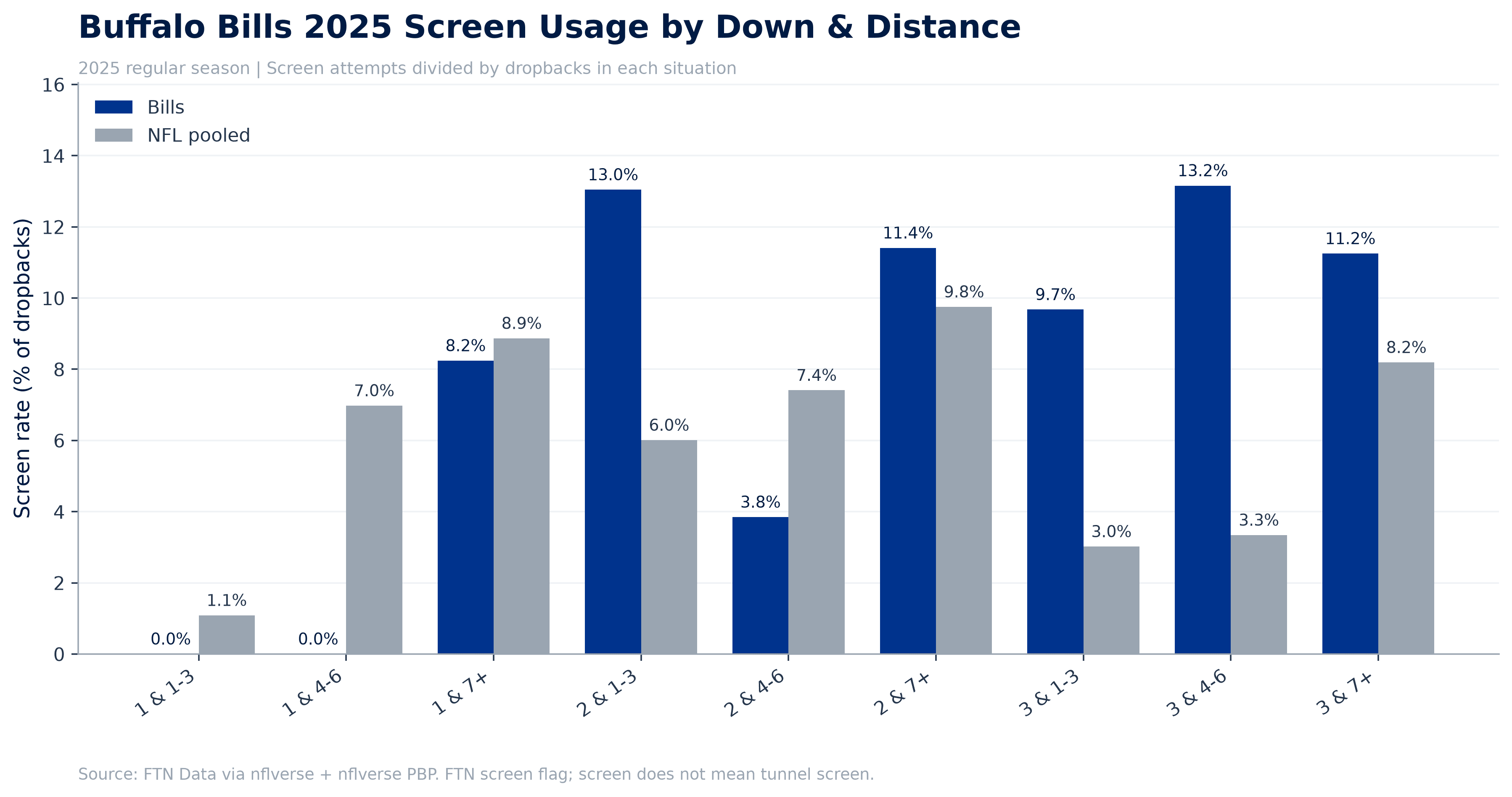
Brady’s biggest problem is that hiding weaknesses seems to be where his approach ends. Even when the offense needs to press its advantage, he keeps reaching for the safe answer. His play designs lack creativity and explosiveness, and he hasn’t shown enough ability to tailor an offense to his quarterback or scheme a No. 1 receiver into a featured role. Too little of this offense is built around Allen’s arm strength, feel for space, and ability to improvise. Nor has Brady established a lead receiver who forces defenses to change how they line up. Buffalo called screens on 9.7% of its third-and-short plays, more than three times the league average. On 3rd & 4–6, that climbed to 13.2%, roughly four times the league average. Screens can be effective, but calling them repeatedly on third-and-medium means passing up chances to attack the sticks directly and betting the conversion on a receiver making someone miss and his blockers doing their jobs. That’s an especially conservative way to use an offense with Josh Allen at quarterback. Once opponents start sitting on the familiar screens, mesh concepts, and zone runs, Buffalo needs a second layer of answers that can break a game open. In the second half of the 2025 season, Allen looked increasingly unsure of himself. The system asks him to work through the play as designed and make the prescribed decision, while his talent and instincts lie in spotting opportunities other quarterbacks don’t see and acting on them immediately. Brady has raised this offense’s floor, but he has also limited how high it can go.
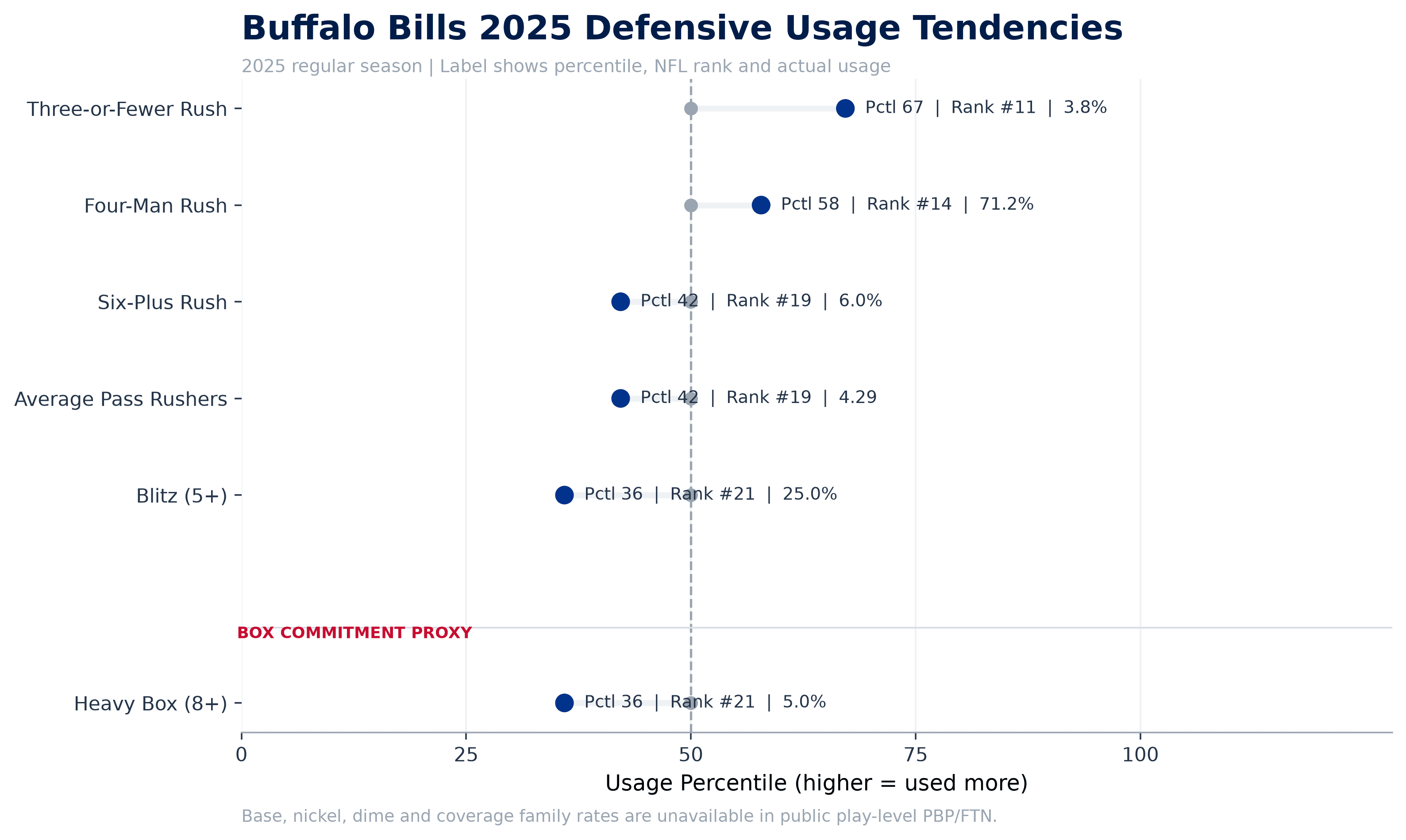
Jim Leonhard’s arrival brings a wholesale change in defensive philosophy. He wants to take a unit that relied on a four-man rush and numbers in coverage to wait out opponents’ mistakes and turn it into one that forces those mistakes. The move from a 4–3 to a 3–4 is only the most visible part of that shift. The real work happens through odd fronts, A-gap disguises, and simulated pressures that conceal where the rush is coming from. Offenses should have a harder time identifying who is coming and who is dropping into coverage before the snap. After blitzing on just 25% of plays in 2025, 21st in the league, Buffalo is expected to bring five-man pressure more often.
The nose tackle is the foundation of that 3–4 front. Lined up head-on over the center or shaded slightly to one side, he has to absorb double-teams and keep offensive linemen from getting clean releases to the second level. Deone Walker has the length, mass, and athleticism to be the most promising option on the roster. The concern is his high center of gravity and a game built more around penetration; he has yet to show he can consistently hold his ground against double-teams. DeWayne Carter can rotate in, but he is also still developing as a traditional nose tackle. If neither can reliably control the A-gaps, Buffalo’s run defense will remain the biggest threat to its championship hopes.
Roster Assessment: Good Depth, But Too Few Difference-Makers
The Bills entered the 2026 offseason with little need for a major rebuild. Josh Allen, James Cook, and an established offensive line give the offense a dependable floor, while Dalton Kincaid, Dawson Knox, and Khalil Shakir are reliable weapons within their roles. On defense, Christian Benford, Greg Rousseau, Ed Oliver, and Cole Bishop give Leonhard a core to build around. Buffalo has most of its starting lineup in place. The concern is that several positions with an outsized impact on playoff games still lack a player who can force opponents to rewrite their game plan.
The most pressing offensive need remains a No. 1 receiver who can beat man coverage outside and consistently threaten defenses downfield. Shakir thrives in the slot, finds soft spots in zones, and creates after the catch. Kincaid can attack the middle, and Cook gives Buffalo a dependable ground game. None of them consistently forces safeties to shade toward the boundary or honor an outside receiver’s deep threat. Keon Coleman’s size and ability to win contested catches add something different, but he still doesn’t separate well enough to take on the full WR1 role. Beyond Shakir, injuries and inconsistent production have left the receiving corps unreliable, at times forcing the tight ends to carry the passing game. Another slot receiver, YAC option, or short-area target would add depth to what Buffalo already does. An outside weapon who forces opponents to change their coverage structure would give Allen a chance to take this offense further.
The clearest defensive needs are strength through the middle and someone who can finish the pass rush. Leonhard’s 3–4 needs a nose tackle who can control the A-gaps and protect the lighter linebackers behind him. It also needs edge rushers who can turn elaborate pressure designs into actual sacks. Walker has the physical tools to play nose, but his instincts still lean toward penetration, and his ability to withstand double-teams consistently remains unproven. Oliver is best when he’s free to attack the B-gap and shouldn’t be saddled with the job of occupying blockers. On the edge, Rousseau is a complete, reliable player whose length and power generate steady pressure. Buffalo still needs a pure speed rusher with the first step, burst, and bend to force tackles to widen their pass sets.
In the secondary, the needs are driven more by the versatility Leonhard’s system demands. Benford can take the opponent’s top receiver, Hairston has the speed to carry vertical routes, and Bishop can work in the box, play robber, or blitz. The Bills still need a safety who can reliably handle the deep part of the field and a nickel who can cover the slot, hold up against the run, and rush off the edge. Without that deep safety, Bishop has less freedom to move toward the line of scrimmage. Without the right nickel, Leonhard’s safety rotations and simulated pressures become more vulnerable to coverage breakdowns.
The offensive line remains a strength, but Dion Dawkins is entering the back end of his career, and Buffalo lacks a proven swing tackle. That makes this a good time to invest in a young, athletic tackle who can develop without being pushed straight into the starting lineup. The position doesn’t need to consume Buffalo’s most valuable resources in 2026. An investment here prepares the roster for the next two or three years, while the immediate gaps in the championship push still need attention.
Buffalo’s offseason needs fall into two groups. A WR1, a speed rusher, and a nose tackle will have the most direct impact on its championship ceiling in 2026. A deep safety, a nickel, and tackle depth will help the roster withstand injuries and prepare for future turnover. Beane has to be careful about filling the roster with useful role players again and coming away without anyone who can change a game. With Allen at quarterback and years of playoff appearances already behind them, the Bills should be aiming higher than a roster with no glaring holes. They need the handful of players who can make an opponent rethink its game plan in January.
The Free Agents Market
DJ Moore — B+
Buffalo sent No. 60 overall to Chicago for Moore and No. 165. I like the decision to spend real draft capital on a receiver who can beat man coverage and threaten defenses downfield. Moore’s strength through contact, acceleration, and ability to create after the catch give Allen a more complete outside target. His build limits his reach on contested throws, but physicality is one of his strengths. He can win space before the catch and punish defenders afterward. That addresses a need Buffalo has spent too long working around.
The reservations are his age, recent production, and the financial commitment beyond this season. Moore enters 2026 at 29, coming off 50 catches for 682 yards, although his five consecutive seasons without missing a game deserve some credit. For this trade to pay off, Brady needs to make full use of his intermediate and vertical game. Moore should give Allen someone to trust against outside man coverage when the offense needs a first down or an explosive play. Feeding him another steady diet of screens would leave too much of this investment on the table.
Bradley Chubb — C
Chubb gives Leonhard a proven starter with power, strong hands, and experience in a 3–4 front. His 8.5 sacks and 20 quarterback hits in 2025 show that he can still produce, and playing all 17 games was an encouraging response to losing the entire previous season to injury. He should help Buffalo compress the pocket and finish some of the opportunities Leonhard’s pressure designs create.
My hesitation is the commitment: three years and $43.5 million, with $29 million guaranteed. That is a substantial bet on his availability. There is value in adding another capable power rusher alongside Rousseau, but Buffalo still lacks the outside speed and bend that would force tackles to defend a different kind of threat. Adding Parker afterward makes that overlap harder to ignore. Chubb can improve this rotation, but expecting him to solve Buffalo’s postseason pass-rush problems would put too much weight on a player with his injury history.
Dee Alford — B
Alford’s contract is more reasonable than the initial headline suggests: three years and $15.75 million in base value, with incentives that could push it to $21 million. That buys Buffalo an experienced nickel at a manageable price. His 2025 production included three interceptions, 13 passes defensed, and two sacks, giving Leonhard someone who can contribute in coverage and bring pressure from the slot.
The concern is how much Buffalo will ask him to handle against the run. At 180 pounds, Alford has limited room for error when bigger receivers engage him or offensive linemen reach the second level. His willingness to tackle helps, but the defensive front still has to keep him in favorable situations. I’m comfortable with the cost of establishing a credible option at nickel while younger players develop. The signing becomes harder to defend if his coverage is inconsistent and opponents can also target him on the ground.
C.J. Gardner-Johnson — B+
Gardner-Johnson might offer the best upside relative to the commitment. A one-year deal worth up to $6 million gives Buffalo an experienced defensive back with a record of creating turnovers and the flexibility to work at safety or in the slot. His six interceptions with Philadelphia in 2024 show the playmaking potential, while his productive finish to 2025 in Chicago suggests there is still something worth betting on.
I like the options he gives Leonhard alongside Bishop. Buffalo can disguise its coverage, rotate a safety down after the snap, and bring pressure without making every assignment obvious beforehand. What still needs to work is the division of responsibility behind those rotations. Gardner-Johnson’s interception totals alone don’t guarantee reliable deep coverage, and Bishop needs a partner he can trust when he moves toward the line. Aggression only helps when someone protects the space behind it. At this price and on a one-year commitment, that is a risk I’m willing to take.
The Draft
Round 2, Pick 35: T.J. Parker, EDGE, Clemson — B-
The Bills traded back multiple times and still landed a first-round talent in T.J. Parker, picking up extra draft capital along the way and adding some much-needed juice off the edge.
Parker is a classic power rusher. He has the upper-body strength to control a tackle’s chest, then work through him with a long arm, bull rush, or club/swim move. His hip and ankle flexibility are nothing special, and neither is his bend. Don’t expect him to consistently threaten tackles with speed, force deep vertical sets, and turn the corner to the quarterback the way Brian Burns or Von Miller can. When an NFL tackle shuts down his initial long arm or power move, his counters still aren’t reliable enough.
Jim Leonhard’s 3–4 defense should suit him well. He can line up at 5- or 7-technique and use his long arm to compress the pocket.
My concern is how much this overlaps with what Buffalo already has. Greg Rousseau and Bradley Chubb fit a similar mold. Rousseau got a five-year extension, Chubb signed for three years, and now the Bills have added a rookie on a four-year deal with many of the same traits. This group still lacks a rusher with the speed and bend to scare tackles around the outside and stretch protections horizontally.
I think Parker has a very real chance to become a dependable, three-down EDGE2 who holds up against the run, collapses the pocket, and gives you seven to ten sacks a year.
Round 2, Pick 62: Davison Igbinosun, CB, Ohio State — C
This was a clear case of scheme fit taking priority over consensus value.
Igbinosun is a big, long, physical boundary corner who wants to get his hands on receivers at the line. He gives Buffalo a different skill set alongside Christian Benford and Maxwell Hairston, and that physicality fits Leonhard’s desire to play more aggressively up front. The biggest concern is how often his hands get him into trouble. He was flagged 30 times over his college career, and the NFL’s rules on illegal contact, holding, and pass interference will leave him even less room for error.
But how badly did the Bills need another outside corner? They traded up to No. 62 for a player who may well spend his rookie year as a backup. For a team still in its Super Bowl window, I think that’s a poor use of resources.
Round 4, Pick 102: Jude Bowry, OT, Boston College — A-
Bowry isn’t ready to start at left tackle in the NFL yet, but getting a developmental tackle with starting-LT tools at No. 102 is good roster building. Buffalo can give him the 2026 season to learn behind Dion Dawkins.
His athleticism stands out. Against speed rushers in particular, he has the feet to make them reach for a counter; simply trying to run around him won’t always work. He can execute vertical sets, 45-degree sets, and more aggressive jump sets, and he shows good awareness when passing off stunts and twists.
I’m a big fan of his ceiling in pass protection. Bowry allowed just two sacks across 335 pass-blocking snaps in 2024. Even with injuries affecting his play in 2025, he didn’t allow a sack in 320 pass-blocking snaps. His recognition of stunts, looping rushers, and delayed pressure is also more advanced than you usually see from a developmental tackle on Day 3. That matters with Josh Allen, who extends plays and regularly asks his tackles to hold up beyond the usual 2.5 to 3 seconds. Bowry’s range and recovery athleticism give him a good foundation for that job.
The concern is his ability to handle power. He doesn’t consistently use leverage to his advantage, and once an edge rusher gets into his chest, his lower-body anchor can give way. He can end up getting walked straight back into the quarterback. His run blocking also needs work before he’s ready to start.
Dawkins is still Buffalo’s left tackle, but his cap hit is set to reach roughly $25 million in 2027. The current contract structure could give the Bills a way to free up substantial cap space by moving on at that point. Bowry is a fourth-round lottery ticket on an inexpensive starting left tackle for 2027 or 2028. That’s a bet I like.
Round 4, Pick 125: Skyler Bell, WR — A-
Getting Bell in the fourth round is good value on its own. Pick No. 125 was also one of the extra assets Buffalo picked up from New England by moving back from No. 28 to No. 31. Expecting a WR1 would be asking too much, but Bell fits Joe Brady’s offense as a Z/slot receiver who can separate and create after the catch.
His game is built on sound fundamentals. He’s already shown he can create separation with NFL-caliber route running, catch the ball reliably, and add yards afterward. What he lacks is that sudden burst out of sharp breaks.
My hesitation is that Khalil Shakir can already do a lot of these things. How much does Allen need another receiver in that mold? There are limits to what you can reasonably expect from a fourth-round wideout, but I hope Brady and Brandon Beane wake up soon. They have a supercar at quarterback and keep driving it like an old Buick.
Round 4, Pick 126: Kaleb Elarms-Orr, LB, TCU — A-
Elarms-Orr is a run-and-chase inside linebacker with range, good coverage awareness, and a varied pass-rush toolbox.
Tackling is his calling card. Leonhard’s aggressive defense will leave linebackers with plenty of one-on-one tackles to make in space. Elarms-Orr looks well suited to a role that asks him to finish those plays himself.
Getting off blocks is his biggest weakness, and it will probably determine whether he becomes a reliable starter. His arms measure just 31½ inches, and his hand usage and leverage are inconsistent on tape.
Leonhard could use him to mug the A-gaps, which plays to his strengths. But linebackers and nose tackles depend on each other. If the defensive line gets reached or beaten by combination blocks, Elarms-Orr will have to take on a 315-pound guard. A lot of his success will depend on how well Buffalo’s front three control their blocks.
Round 5, Pick 167: Jalon Kilgore, CB/S, South Carolina — A-
I see Kilgore primarily as a robber or a safety who plays down near the line. At 6’1” and 210 pounds, he has a safety’s build, along with 4.40 speed and excellent length. Getting a defensive back with those tools and a clear NFL role at No. 167 is good Day 3 business.
Kilgore spent much of his college career playing STAR. His best fit is as a big nickel, box safety, or tight end matchup defender. He has the size and length to handle tight ends and can step into the box to take on run-fit responsibilities. That should work well in Leonhard’s system, with its emphasis on varied coverages and disguise. Leonhard can show him in the slot or the box before the snap, then have him cover a tight end, rob the middle, or blitz.
There are limits to that versatility, though. The 4.40 speed is real, but his lateral agility and change of direction are fairly ordinary. Shifty slot receivers can separate from him on sharp breaks. I’d be much more comfortable matching him against tight ends and bigger slots than asking him to handle a full-time nickel corner role. I also wouldn’t make single-high free safety his regular assignment. His best work comes closer to the line of scrimmage.
He brings good downhill burst and physicality in run support, but his tackling technique needs to become more consistent. He sometimes relies too heavily on diving at legs or going for ankles. In coverage, he gets by more on reactions and athleticism than anticipation, which still needs work.
The appeal for Buffalo is the low cost. Kilgore doesn’t have to start as a rookie. He can earn snaps on special teams and in big nickel packages while he develops. If he grows into someone Leonhard can trust to cover tight ends, support the run, and blitz in certain situations, he’ll have a useful role in this defense.
That’s good value at No. 167. How much more he becomes will depend on Buffalo’s patience and how far his coverage technique progresses.
Round 5, Pick 181: Zane Durant, DT — B+
Durant feels like a nice little steal here. He’s a classic undersized, penetrating 3-technique. At 6’1” and 290 pounds, with shorter arms, he gives up size and length, but his first-step quickness and explosiveness stand out. He plays low and uses violent hands to attack the A- and B-gaps. Leonhard’s multiple fronts should give him opportunities to use those traits. I’d like to see Buffalo get him moving on slants, stunts, and loops, where he can penetrate and disrupt plays. Asking him to stand his ground and trade power with NFL guards would waste much of what makes him interesting.
That also gets to my biggest reservation about this pick. Buffalo has struggled against the run inside for several seasons, and Durant does little to address that. His size and length will make it difficult to consistently anchor against double-teams or handle two-gap assignments. Once an offensive lineman gets into his chest, he could become someone opponents deliberately run at. The Bills have added another undersized interior lineman whose game revolves around penetration and athleticism. They still need a dependable run defender who can occupy blockers in the middle and keep their lighter linebackers clean. Durant gives Leonhard more options up front, but Buffalo’s clearest structural weakness remains.
I see him as a rotational 3-technique and an interior pass rusher on passing downs, with a full-time, three-down role a tougher projection. There’s little risk at No. 181. But if teams keep moving Buffalo off the ball with duo, inside zone, and short-yardage runs, this pick will bring us back to the same question: why does interior run defense keep falling down the priority list?
Round 7, Pick 220: Toriano Pride Jr., CB, Missouri — B+
Pride is a developmental corner whose game starts with speed. His 5’10”, 185-pound frame doesn’t stand out, but a 4.32 forty gives him the wheels to recover and stay with receivers downfield. He played mostly outside in college, and my starting point would be to develop him in off-man and match coverages. A move to the slot would take some projection.
If Pride does prove he can play inside, Buffalo could get a lot out of the 220th pick. But playing the slot demands lateral quickness, route anticipation, run support, and reliable tackling. Straight-line speed only gets you so far, and Pride still has things to prove in all of those areas.
There’s another wrinkle here. If a seventh-round rookie can quickly push Dee Alford for the nickel job, that would be a win for the pick. It would also invite another look at the three-year deal Buffalo gave Alford this offseason. He was a significant free-agent addition brought in to fill that exact role. If Pride can provide similar play at a fraction of the cost, Beane’s allocation of resources in the secondary deserves some scrutiny.
Taking a chance on a 4.32 SEC corner at No. 220 carries very little risk. For now, I’d pencil him in as a CB4/CB5 who contributes on special teams. His ceiling will come down to whether his coverage technique, tackling, and ability to process the game from the slot can catch up to his speed and make him a viable NFL rotational player.
Round 7, Pick 239: Tommy Doman, P, Florida — C+
A seventh-round punter costs very little in draft capital, but Doman was one of just three specialists drafted in 2026, so I want to see a clear payoff. His strengths are hang time, directional punting, and kickoff experience. His raw leg strength and touch when trying to pin opponents deep don’t clearly put him in the top tier of punting prospects. What puzzles me more is that Buffalo had already re-signed an experienced NFL punter in Mitch Wishnowsky, who put nearly half his punts inside the 20 in 2025. There was already a credible option on the roster. If Doman offers roughly the same level of play, spending a pick on another punter adds little. For this choice to make sense, he needs to win the job outright with more consistent hang time and directional control, while also showing that his college kickoff ability translates to the NFL. Otherwise, even at No. 239, I think Buffalo spent a pick at a position where comparable production is relatively easy to find.
Round 7, Pick 241: Ar’maj Reed-Adams, G, Texas A&M — A-
Reed-Adams might be my favorite of Buffalo’s late picks when weighing both need and value. He’s 6’5” and 314 pounds, with arms over 34 inches long, extensive starting experience, and college snaps at both guard spots and tackle. Getting an NFL-sized lineman who can provide depth at multiple spots inside at No. 241 is a pick I like a lot.
His strengths are power and downhill run blocking. He has the size and anchor to hold up physically, and he can move defenders on power concepts, combination blocks, and assignments that ask him to work in a small area. There’s a clear path for him to stick in the league as a backup guard.
Pass protection is where the work needs to happen. His lateral quickness is average, and he doesn’t consistently sort out stunts, twists, or late blitzers. His hand placement and body control are also rough. The penalties he piled up over six college seasons point to a player who still needs to clean up his technique and discipline.
At No. 241, I can live with those flaws. Buffalo needs interior offensive line depth, and Reed-Adams has the experience and physical tools to become the third or fourth guard on the roster. If injuries hit, I think he has a chance to be a spot starter the Bills can trust. Some of Buffalo’s earlier picks came at a premium for scheme fit. This one is straightforward value.
Conclusion
Buffalo has made enough good moves to justify some optimism, but I’m still not convinced it has fixed the problems that keep ending its season. Moore gives Allen a credible outside weapon, and there is real value in a draft class that should improve depth and provide affordable starters down the road. My concern is how much of the immediate defensive improvement still depends on projection: an unproven answer at nose tackle, the health of a veteran pass rusher, and a new coordinator making overlapping skill sets work together. Brady now has fewer excuses for an offense that becomes cautious when it needs to attack. Leonhard has more ways to disguise pressure, but those designs will accomplish little if opponents can keep running through the middle. Allen should keep Buffalo firmly in contention. Whether this offseason takes the Bills further will depend on how much help he gets when the game tightens: a receiver winning outside, a third-down pressure becoming a sack, or the defense finally getting off the field. After three straight three-point exits, those are the improvements Buffalo has to deliver.